How natural hairline design is created in hair transplant surgery: position, shape, density gradient, micro-design and the principles that separate natural
Of everything that determines whether a hair transplant looks natural or artificial, hairline design is the single most important factor. Not technique. Not graft count. Not the technology used. The hairline — its position, shape, density gradient and angle — is what the world sees when they look at your face. Get it right and the result is invisible. Get it wrong and it is permanent.
The Science and the Art
Hairline design in hair restoration surgery sits at the intersection of two disciplines: facial anatomy (a science with measurable parameters) and aesthetic judgement (an art that requires years of refinement). The best results are produced by surgeons who command both.
The science defines constraints: the Rule of Thirds, the appropriate height range for a given face shape and age, the standard temple recession angle for different ethnicities, and the anatomical zones of the frontal scalp. These constraints produce a range of acceptable hairline positions — but not a single correct answer.
The art determines the optimal answer within those constraints: the specific position that looks right for this face, this age, this ethnicity, this life expectation. This judgment cannot be templated or algorithmically generated. It is developed through thousands of cases and refined through critical assessment of long-term results.
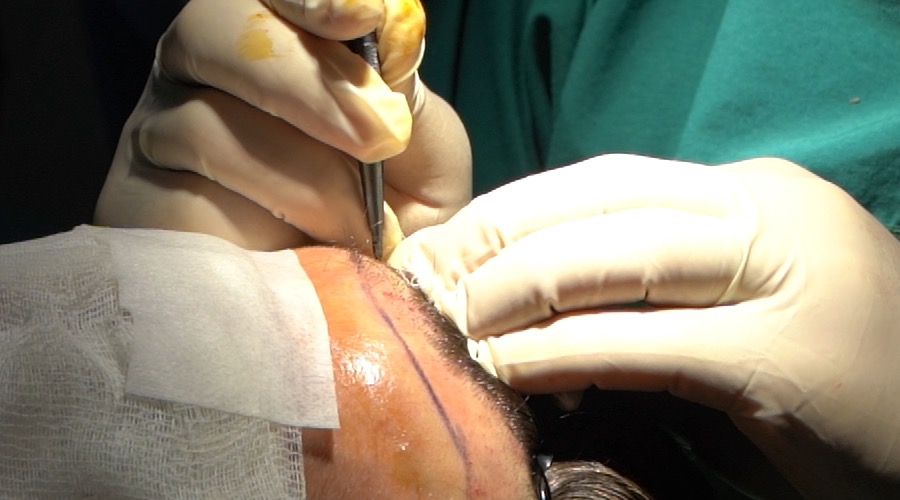
At Hairmedico, every hair transplant procedure begins with a 20–30 minute hairline design session — Dr. Arslan with the patient, upright, in natural light, drawing directly on the scalp with surgical marker. No templates. No digital simulations that replace judgment. The patient sees and approves the design before anaesthesia is ever administered.
The Rule of Thirds and Facial Proportions
The classical framework for hairline positioning is the Rule of Thirds: the face is divided into three equal horizontal zones — hairline to brow ridge, brow ridge to base of nose, base of nose to chin. A hairline that produces equal thirds is considered proportionally balanced.
In practice, this rule provides a starting point, not a rigid prescription. Several factors modify the Rule of Thirds in hair restoration planning:
Age modification: A 25-year-old with a Norwood III recession has a different appropriate hairline than a 50-year-old with the same loss pattern. The Rule of Thirds produces a position that may look too youthful for an older patient's face — creating an incongruity that reveals surgery rather than concealing it.
Forehead height: Long foreheads (above 7.5cm from brow to hairline) may benefit from a lower hairline position for proportional balance. Short foreheads (below 6cm) require conservative positioning to avoid an unnatural low-set appearance.
Facial shape: Round faces typically benefit from slightly higher, more angular hairlines that add vertical visual length. Oval faces accommodate wider variation. Long faces require careful avoidance of positions that further elongate.
Ethnic considerations: Hairline position norms vary between ethnic groups. Mediterranean and Middle Eastern patients typically have lower native hairlines than Northern European patients. African and Caribbean patients have specific native hairline shapes that require ethnically appropriate design — not adapted from a European template.
Hairline Shape: The Variables That Create Naturalness
Position is only one dimension of hairline design. Shape — the precise contour of the hairline across the forehead — is equally important and far more technically demanding to execute well.
| Design element | Natural appearance | Artificial appearance |
|---|---|---|
| Leading edge regularity | Soft, slightly irregular micro-contour | Straight, geometric edge |
| Side symmetry | Near-symmetric with subtle variation | Perfect geometric symmetry |
| Density at border | Fine single hairs at leading edge | Dense multi-hair grafts at leading edge |
| Temporal recession angle | Slight recession that matches native ethnic norm | No recession — unnatural square shape |
| Central peak | Subtle, soft central peak or widow's peak | No peak (flat) or exaggerated peak |
| Transition zone | Gradual density increase from border inward | Abrupt jump from bare skin to dense hair |
The most common cause of obviously artificial-looking hairlines is the last error in this table: dense multi-hair grafts placed directly at the leading edge, producing an abrupt wall of hair rather than a natural gradation. In a native scalp, the hairline's leading edge contains almost exclusively single-hair follicular units — each hair standing slightly separated from its neighbors, creating a soft, organic border.
Macro-Design and Micro-Design
Professional hairline planning operates at two scales simultaneously: macro-design and micro-design.
Macro-design determines the overall shape and position: where does the hairline sit, what is the temple recession angle, is there a widow's peak, how does the hairline relate to the patient's specific facial anatomy? This is the design the patient sees and approves in the design session.
Micro-design determines the individual graft-level execution: which specific sites receive single-hair grafts, where the transition from 1FU to 2FU to 3FU occurs, the exact angle of each channel, the depth of implantation. This is the design the surgeon executes during the surgical phase — invisible to the patient, entirely dependent on the surgeon's skill and aesthetic judgment.
Dr. Arslan Musbeh has developed his micro-design approach over 3,000 personal cases. The subtle irregularity he builds into leading-edge placement — preventing the "too perfect" regularity that reveals surgery — is one of the most valued aspects of Hairmedico results as described in patient reviews.
Learn about Dr. Arslan's qualifications and approach to personalised hair restoration.

Designing for 20 Years, Not for Today
The most consequential hairline design error is not a technical one — it is a temporal one. Designing a hairline for how the patient looks today, without accounting for how they will look in 20 years, produces a result that ages poorly.
A hairline designed at its lowest possible position for a 28-year-old creates a specific problem: as native hair continues to recede around the transplanted zone (transplanted hair is permanent; native hair is not), the transplanted hairline becomes increasingly isolated — an island of dense hair floating above continuing recession. The correction of this outcome requires either a second transplant to cover the recession, or corrective surgery to raise the hairline, or both.
Dr. Arslan's approach: "I design for the patient's 50-year-old face, not their 30-year-old hairline preference. My job is to ensure the result still looks right in 20 years — not just excellent today." This means the hairline position may be slightly more conservative than some patients initially prefer. The discussion always includes a long-term simulation of projected loss without medical management, and with Finasteride, to help the patient make an informed design decision.
Ethnic Hairline Design: One Template Does Not Fit All
Hair restoration surgery has historically been dominated by techniques developed for and by Caucasian surgeons treating Caucasian patients. The result: a lingering tendency to apply European hairline aesthetics universally — with predictably poor results for patients of different ethnic backgrounds.
Dr. Arslan's patient base spans patients from the Middle East, North Africa, Sub-Saharan Africa, East Asia, South Asia, and across Europe and the Americas. Each ethnic group has specific native hairline norms:
- Mediterranean / Middle Eastern: Lower baseline hairline position, strong central peak common, denser hairline zone appropriate
- Northern European: Higher baseline position, M-shaped recession typical, conservative design appropriate
- African / Caribbean: Specific frontal hairline shape with flat central section, specific temporal recession pattern, low-fade hairline aesthetics may influence design preferences
- East Asian: Often higher baseline position, less temporal recession in native pattern, specific hair angle considerations due to straight, coarse hair
A hairline design that fails to account for ethnic norms does not just look "not quite right" — it can look obviously unnatural to anyone familiar with the patient's ethnic aesthetic context.
Temple Points: The Often-Neglected Detail
Temple points — the small extensions of hair that frame the face at the temples — are one of the most youth-restoring elements of hairline restoration and one of the most commonly neglected. In androgenetic alopecia, the temples are typically the first zones to recede. Restoring them — even with a modest number of grafts — dramatically changes the framing of the face and creates a more complete restoration.
Temple point restoration requires specific skills: the grafts in this zone must be placed at very acute angles (nearly flat to the skin surface), in very fine single-hair units, with natural recession that matches the wider hairline design. Done well, the result is the detail that transforms a "hair transplant result" into simply "his hair." Done poorly, the temple points look grafted or incongruous with the native hair.
The Hairmedico Design Process
Every Hairmedico design session follows the same protocol:
- Upright position: Design is conducted with the patient seated — never lying down. Gravity, facial expression and natural head position all affect how a hairline will look in daily life.
- Dry scalp and natural light: Hair products removed. No flash photography. Natural clinic lighting to assess the scalp as it will be seen in real conditions.
- Incremental discussion: Dr. Arslan draws the proposed hairline and discusses the design elements — position, peak, temple recession, symmetry — before the patient approves.
- Long-term simulation: The projected 10 and 20-year hair loss trajectory is discussed and the design is adjusted if appropriate.
- Patient sign-off: The patient approves the design verbally and the design is photographed for the surgical record.
- No changes after anaesthesia: No design modifications are made after the patient is anaesthetised. The approved design is the surgical plan.
For Hairmedico pricing and package details, visit hairmedico.com/price.