Overview
Hair
Transplant
Turkey

Surgeon-led hair restoration clinic in Levent, Istanbul since 2007.

Explore all →
Lorew Paris
Premium hair care by Hairmedico
Discover →
Confidential · Free
Bespoke Assessment by Dr. Arslan

Send 3–5 photographs. Personal response within 24 hours — no intermediaries.

Request Now →
17+
Years
1
Patient/day
Surgery
Techniques
& Procedures

Selected for your specific hair loss pattern and aesthetic goals.

FUE vs DHI →
Interactive Tool
Which Technique Is Right for You?

FUE, DHI or Algorithmic FUE™ — Dr. Arslan recommends based on your photographs and Norwood stage.

Get Assessment →
Try Graft Calculator →
Why Turkey
World-class
surgery.
Local price.

FUE Europe member. Ministry of Health accredited clinic. Levent, Istanbul — 60–80% less than UK or US.

View Package →
The Surgeon
Dr. Arslan
Musbeh

FUE Europe member. Ministry of Health accredited. 17+ years. 4,500+ personal procedures. One patient per day.

Full Profile →
Dr. Arslan · Istanbul
"One patient. One day. No exceptions."

Every graft personally placed. Every result personally accountable.

Read Philosophy →
17+
Years
4,500+
Cases
FUE
Europe
Pricing
All-Inclusive
Packages

No hidden costs. Hotel, transfers, surgery and aftercare in one price.

View Pricing →
Most Chosen
VIP — FUE–DHI

Silver · Gold · VIP — 5-star hotel · Airport transfers · PRP included

View Pricing →
Graft Calculator →
Results
Real
Before
& After

Every case personally performed by Dr. Arslan Musbeh.

Full Gallery →
Non-Surgical
Beyond
Surgery

Not every case needs a transplant. Medical treatments, therapies and specialist options.

Overview →
Medical Education
Learn
before
you decide.

Guides, tools and expert content — written by Dr. Arslan Musbeh.

All Articles →
Bespoke Assessment WhatsApp
Hair Transplant
Hair Transplant Turkey
Techniques
Techniques
Procedures
Why Turkey
Country Comparisons
Non-Surgical
Medical Treatments
Learn
Guides & Tools
Clinic Dr. Arslan Musbeh Pricing & Packages Before & After About Hairmedico Contact
FUE Europe Member
1 Patient / Day
250+ Physicians Trained
Home/ Hair Restoration/ Hair Loss in Men
Men's Hair Loss Guide

Hair Loss in Men —
Causes, Stages & Solutions

By age 50, half of all men experience significant hair loss. Understanding the cause — and knowing the right treatment window — makes all the difference between reversing it and living with it.

85%
of men affected by 50
18
earliest age of onset
95%
androgenetic cause
Dr. Arslan Musbeh hair loss specialist Istanbul Hairmedico surgeon
Root Causes

Why Men Lose Their Hair —
The 6 Main Causes

95% of male hair loss is androgenetic alopecia — caused by DHT. The other 5% has treatable medical causes. Knowing which you have changes the entire treatment approach.
95%
Androgenetic Alopecia (MPB)
DHT (dihydrotestosterone) binds to genetically sensitive follicles, shortening their growth cycle until they miniaturise and stop producing hair. The pattern follows the Norwood scale.
How DHT works →
2%
Alopecia Areata
An autoimmune condition where the immune system attacks hair follicles, causing patchy hair loss. Often reversible with treatment. Hair transplant is not appropriate until the condition is stable.
Autoimmune — needs specialist
1.5%
Telogen Effluvium
Stress, illness, surgery, rapid weight loss or nutritional deficiency pushes hair into a resting phase. Hair sheds heavily 2–3 months after the trigger. Usually temporary and reversible.
Usually temporary
1%
Medical / Hormonal
Thyroid dysfunction, iron deficiency, anaemia, or certain medications (chemotherapy, blood thinners, steroids) can trigger hair loss. Always exclude these before considering surgery.
Blood panel required
<1%
Scarring Alopecia
Inflammatory conditions destroy follicles permanently, leaving scar tissue. Hair transplant can restore hair to scarred areas if the condition is stable. Requires specialist dermatology assessment.
Scar repair →
<1%
Traction / Mechanical
Tight hairstyles (cornrows, man buns) over years cause traction alopecia. If caught early, stopping the tension allows regrowth. Chronic cases may require transplant along the hairline.
Often preventable
The Science

How DHT Causes
Hair Loss in Men

DHT (dihydrotestosterone) is formed when testosterone is converted by the enzyme 5-alpha reductase. In men with genetic sensitivity, DHT slowly destroys hair follicles in a predictable pattern — the same pattern shown on the Norwood scale.

1
Testosterone → DHT
The enzyme 5-alpha reductase (5-AR) converts testosterone to DHT in the scalp. Men with more 5-AR produce more DHT locally.
Enzyme trigger
2
DHT Binds to Follicle Receptors
DHT attaches to androgen receptors in genetically sensitive follicles — primarily in the front, top and crown. Side and back follicles lack these receptors, making them DHT-resistant.
Genetic sensitivity
3
Anagen Phase Shortens
Each hair growth cycle (anagen phase) gets progressively shorter. Hair that used to grow for 5 years now grows for 2 years, then 6 months, then weeks.
Miniaturisation begins
4
Follicle Miniaturisation
The follicle physically shrinks. Hair becomes thinner, shorter, and lighter (vellus hair) until it eventually stops producing visible hair altogether.
Visible thinning
5
Permanent Loss — Unless Transplanted
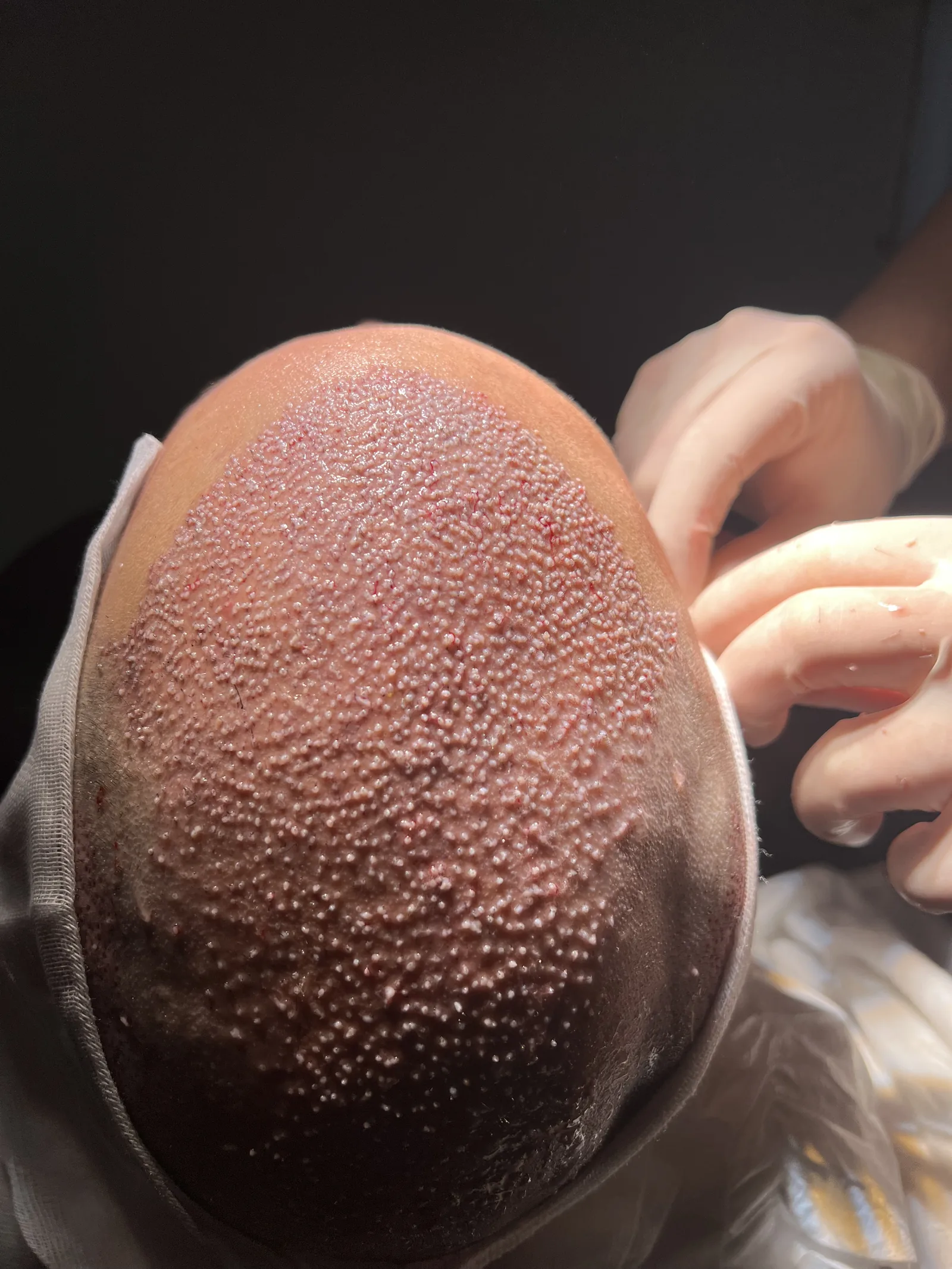
Once a follicle is dormant, only a hair transplant restores hair. DHT-resistant follicles from the donor zone are permanently resistant — they continue to grow for life when transplanted.
Transplant restores permanently
Male pattern baldness hair transplant before after result DHT treatment Hairmedico
DHT-Resistant Donor Grafts
Transplanted follicles from the permanent zone keep their DHT-resistance for life — and keep growing permanently at the recipient site
Prevalence

How Common Is Male
Hair Loss by Age?

20s
20%
Affected
30s
30%
Affected
40s
40%
Affected
50s
50%
Affected
60s
65%
Affected
70s
80%
Affected

Source: American Hair Loss Association · ISHRS · 2024 global estimates

Classification

Types of Hair Loss —
What You Need to Know
Most common
Androgenetic Alopecia
The classic male pattern — receding temples and thinning crown, following the Norwood scale. Genetic and progressive. DHT-driven. Affects 95% of men who lose their hair.
Treatment: Hair transplant, Finasteride, Minoxidil
Autoimmune
Alopecia Areata
Patchy, sudden hair loss caused by the immune system attacking follicles. Can affect the scalp, beard, or body hair. Often responds to corticosteroids or immunotherapy.
Treatment: Immunotherapy — not transplant
Reversible
Telogen Effluvium
Diffuse shedding 2–3 months after a physical or emotional stressor. Fever, surgery, extreme dieting, illness. Usually resolves within 6–9 months after removing the trigger.
Treatment: Address cause · PRP · Minoxidil
Rare
Scarring Alopecia (Cicatricial)
Inflammation destroys the follicle permanently, replaced by scar tissue. Includes lichen planopilaris, frontal fibrosing alopecia. Transplant possible to scarred areas when stable.
Treatment: Scar repair transplant (when stable)
Preventable
Traction Alopecia
Hair loss along the hairline caused by chronic tension — tight styles, extensions, braids. Early cases reverse if the tension is removed. Advanced cases may need transplant along the hairline.
Treatment: Stop tension + PRP · Hairline transplant
Reversible
Anagen Effluvium
Rapid hair loss during the growth phase — most commonly caused by chemotherapy or radiation. Hair usually regrows after treatment ends. PRP can support regrowth speed.
Treatment: PRP · Wait for treatment to end
Your Options

Treatment Options for
Male Hair Loss

The right treatment depends on your hair loss type, stage and goals. Here is an honest overview of every option — surgical and non-surgical.
Hair Transplant
Surgical — Permanent
  • Only permanent solution for androgenetic alopecia
  • Grafts from DHT-resistant donor zone — grow for life
  • Sapphire FUE, DHI or Algorithmic FUE™ at Hairmedico
  • Natural hairline design by Dr. Arslan — not a template
  • One patient per day — 6–8 hours of undivided care
Learn about hair transplant
Finasteride (Propecia)
Medical — Ongoing
  • Blocks 5-alpha reductase — reduces DHT by ~70%
  • Slows or stops progression in most men
  • Works best at Norwood I–III before significant loss
  • Must be taken daily — stops working if discontinued
  • Side effects possible — discuss with Dr. Arslan
Finasteride guide
Minoxidil (Rogaine)
Topical — Ongoing
  • Widens blood vessels, prolongs anagen phase
  • Applied directly to scalp — 2× daily or oral version
  • Best for vertex/crown — less effective at hairline
  • Results in 4–6 months — must continue indefinitely
  • Often combined with Finasteride for best effect
Minoxidil vs Finasteride
PRP Therapy
Non-Surgical — Supportive
  • Platelet-rich plasma from your own blood
  • Injected into scalp — stimulates dormant follicles
  • Best results when combined with Minoxidil or Finasteride
  • Also used post-transplant to support graft survival
  • 3–6 sessions recommended, then annual maintenance
PRP treatment guide
FAQ

Common Questions About
Male Hair Loss

Not sure where to start? Send photos of your hair and Dr. Arslan's team will assess your stage and recommend the right treatment — free, within 24 hours.

Ask Dr. Arslan's Team
Is hair loss inherited from mother or father?+
Both parents contribute. The primary gene is on the X chromosome (inherited from the mother), but multiple other genes from both parents also play a role. If your maternal grandfather was bald, your risk is elevated — but it is not the only factor.
Can hair loss be reversed without surgery?+
In the early stages (Norwood I–II), medical treatment with Finasteride and/or Minoxidil can slow or stop progression — and sometimes cause partial regrowth. Once follicles are permanently dormant (typically Norwood III+), only a hair transplant can restore hair to those areas.
At what age should I get a hair transplant?+
Dr. Arslan recommends waiting until the hair loss pattern is stable — typically mid-20s at earliest. Operating too young risks the transplanted hairline looking unnatural as surrounding hair continues to recede. A thorough assessment determines the right timing for each individual.
Does stress cause permanent hair loss?+
Stress causes telogen effluvium — a temporary, diffuse shedding that usually reverses within 6–9 months once the stressor is removed. However, stress can accelerate or unmask underlying genetic hair loss in men who are predisposed to MPB.
Does wearing a hat cause hair loss?+
No. Wearing a hat does not cause male pattern baldness. This is a myth. Hair loss is genetic and hormonal — not caused by hats, hair washing frequency, or blood flow to the scalp.
How do I know which Norwood stage I am?+
Visit the Norwood Scale guide and compare your hairline to the diagrams. Alternatively, send photos to Hairmedico via WhatsApp — Dr. Arslan's team will identify your exact stage and recommend the right treatment within 24 hours.
Free — No Obligation
Ready to Understand
Your Hair Loss?

Send photos of your hair via WhatsApp. Dr. Arslan's team will identify your Norwood stage, explain the cause, and recommend the right treatment — within 24 hours. No sales pressure, honest answers.